
By: Whova Team | Last Updated: August 20, 2026
Event management is the professional discipline of planning, organizing, and delivering an event from initial concept through post-event evaluation.
No matter whether you are hosting an in-person conference, a virtual training series, or a hybrid annual meeting, the stages are the same, even if the tools differ.
This guide explains what sets event management apart from event planning and walks through the six steps of the event management process, including which tasks you can streamline with event management software.
How is Event Management Different From Event Planning?
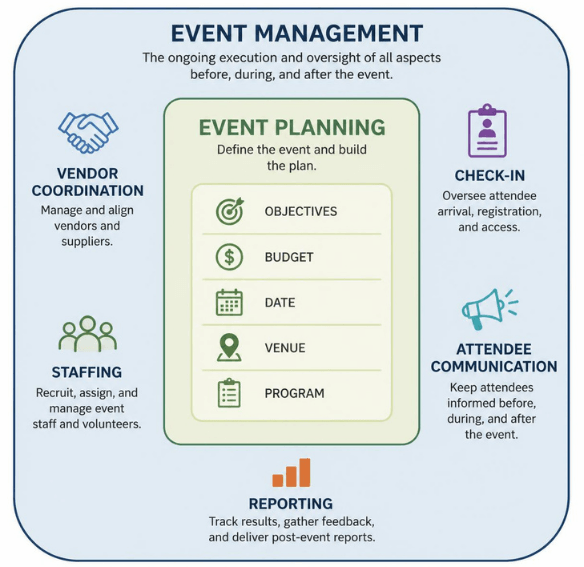
Event planning is the pre-event phase. Planners set the objectives and the budget, then build the program around a date and a venue.
Event management is the whole lifecycle. It starts with that planning work and continues through execution and evaluation, so it also covers vendor coordination, staffing, check-in, attendee communication, and the reporting you do once the event is over.
Both event planners and event managers exist as job titles. Larger organizations might hire a planner for the design work and hand the plan to a manager for execution. On a small team, it’s more likely that one person does both.
Understanding the difference matters when you’re shopping for event management software. A tool built around the event planning timeline and task lists covers the first phase and stops there. Anyone responsible for the full lifecycle needs check-in, attendee communication, and post-event reporting in the same system, which is what an all-in-one platform does.
| Phase / Focus | Event Planning | Event Management |
| Primary Stage | Pre-event design | End-to-end execution & post-event lifecycle |
| Core Tasks | Theme creation, menu selection, date scheduling | Vendor logistics, on-site coordination, technical troubleshooting |
| Primary Goal | Build the event blueprint | Run the event smoothly and measure success |
Why Event Management Matters
Freeman research conducted by The Harris Poll found that 95% of attendees trust brands and organizations more after taking part in an in-person event. That goodwill drives renewals, repeat registrations, and sponsorship income.
It also raises the stakes for execution. A venue is booked once, an audience travels once, and any mistake plays out in front of everyone at the same time.
Most event day errors trace back to two things: poor communication between teams and no contingency plan when something goes wrong. Neither is inevitable. Both are the result of treating event management as an operational afterthought rather than a strategic function.
Generally, smaller teams have less margin to absorb a last-minute supplier failure, a scheduling conflict, or a budget overrun. Structured event management protects the resources those teams cannot afford to waste: time, money, and the energy of staff who are already stretched.
The right tools can take on part of that load. An event app, for example, lets attendees check the schedule and find their own room, so a three-person team is not fielding the same question over and over again.
What are the Essential Steps in the Event Management Process?
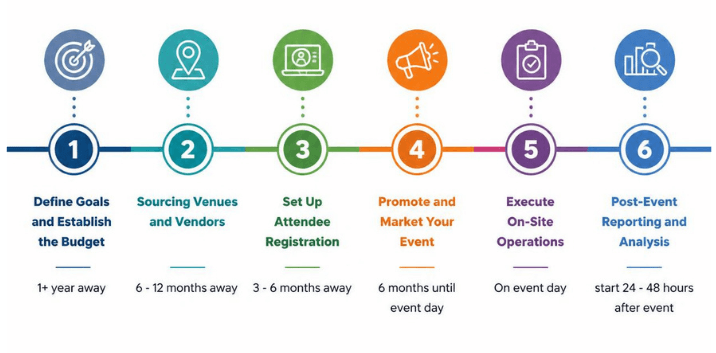
Every successful event follows the same basic sequence, whether you are running a 50-person board retreat or a 5,000-person annual conference. Here is a six-step framework that works across formats and team sizes.
Step 1: Define Goals and Establish the Budget
Two questions come first: who is this event for, and what does success look like?
The second one needs a number attached. “Raise our profile in the sector” gives you nothing to plan against or report on afterward. Four hundred registrations, $60,000 in sponsorship, or 70% session attendance tells you what to build the budget and the marketing plan around.
Then build the budget around those targets. Calculate the break-even point early, factoring in both your costs and your income streams: ticket sales, sponsorship, and any grants or subsidies relevant to your sector. Set aside 10% to 15% for contingencies. Supplier changes and last-minute logistics issues rarely announce themselves in advance.
Step 2: Sourcing Venues and Vendors
Six to twelve months out is not too early. The best venues fill up fast, and booking well in advance gives you more leverage on price and terms.
When evaluating venues, go beyond capacity. Look at accessibility for your attendees, parking and public transit options, what’s included in the hire fee, and what the cancellation policy looks like. A venue that fits your headcount but has a rigid cancellation clause can become a liability if anything shifts.
Vendors are a separate conversation. Caterers, AV teams, and decor vendors each have their own lead times, requirements, and day-of dependencies. Get multiple quotes, and check references. Brief each vendor on the spatial layout and technical requirements as soon as contracts are signed. Assumptions about room setup are among the most common causes of day-of problems, and they are almost always avoidable.
Step 3: Set Up Attendee Registration
Registration is the first experience most attendees have with your event. A clunky process leaves a poor impression before anyone has walked through the door.
Forms should accommodate different ticket types, member and non-member pricing, and any custom questions you need answered upfront. Dietary requirements, accessibility needs, session preferences, and company size all sound minor until you are trying to gather them three days before the event.
What happens after someone registers matters just as much. A clear confirmation email with event details, a calendar invite, and a simple outline of next steps reduces inbound questions and sets expectations before anyone has shown up. Whova supports all of this, and its automatic reminders recover abandoned registrations without anyone on your team having to follow up manually.
Step 4: Promote and Market Your Event
Reach your audience through targeted email campaigns, LinkedIn, your association website, and any partner newsletters relevant to your sector.
Promotion works best when it follows a sequence. Start with a save-the-date as soon as the event is confirmed, use speaker announcements to build momentum in the weeks that follow, and drive urgency with an early bird deadline. Save a final push for the last two weeks. Campaigns that go out all at once tend to get ignored; ones that build over time give your audience multiple reasons to register.
The one thing that can undermine all of it is inaccurate information. Speaker changes and schedule updates happen constantly in the weeks before an event, and a session listed incorrectly on your website can cost you registrations. Managing those updates manually across multiple channels is where small teams lose hours they do not have. That is why Whova built dynamic widgets that embed directly onto your site and update automatically whenever something changes in the dashboard.
Step 5: Execute On-Site Operations
Check-in is usually the first pressure point. Long queues frustrate attendees before the program has started. QR code check-in and on-the-spot badge printing keep arrivals moving and free your staff to focus on guests rather than paperwork.
Before doors open, make sure every team member knows exactly what they are responsible for. A detailed run-of-show shared in advance and a live channel for flagging issues in real time are what keep on-site operations from unraveling when something unexpected happens.
From there, the job is staying ahead of the event rather than reacting to it: managing room transitions, supporting speakers, and handling requests before they become problems. Whova’s in-app polls and community boards give organizers a live read on how things are landing while there is still time to act on it.
Step 6: Post-Event Reporting and Analysis
Sponsors want numbers. Boards want to see the return. Your own team needs to know what worked before the next planning cycle begins.
Follow up with attendees within 48 hours while the experience is still fresh. A thank you email with session recordings or key takeaways shows attendees their time was well spent. Include a short survey asking what worked, what did not, and what would bring them back. That feedback is the most useful input you have going into the next planning cycle.
Compiling that data manually is slow and prone to errors, which is the last impression you want to leave with stakeholders. Whova generates post-event reports automatically, covering registration, check-ins, and session engagement in a format ready to hand over. The faster the results arrive, the easier it is to build the case for the next event.
What Skills Are Required For Event Management?
Event management is a broad discipline at the intersection of operations, communication, and people management. Here are the skills you need to do it well.
Project management: One delayed contract pushes back the venue brief, which pushes back the run-of-show. Keeping interdependent workstreams on track is the core of the role.
Budget management: Costs shift constantly and the budget needs to reflect that in real time. Knowing where your break-even sits at any given moment is non-negotiable.
Negotiation: Event management is full of competing interests. Vendors want flexibility, sponsors want exclusivity, speakers want more than the budget allows. Getting to workable agreements on all sides without burning relationships is a skill in itself.
Attention to detail: A wrong session time or a speaker briefed on the wrong room sounds minor until it isn’t. Small errors compound fast and are almost always avoidable.
Composure under pressure: Something will go wrong on the day. The skill is handling it without the attendee ever knowing.
Stakeholder management: Sponsors, boards, and speakers all need different things from you simultaneously. Managing those expectations without dropping any of them is harder than it sounds.
Adaptability: Plans change. The best event managers have a backup before they need one.
How Can Event Management Software Streamline Your Next Event?
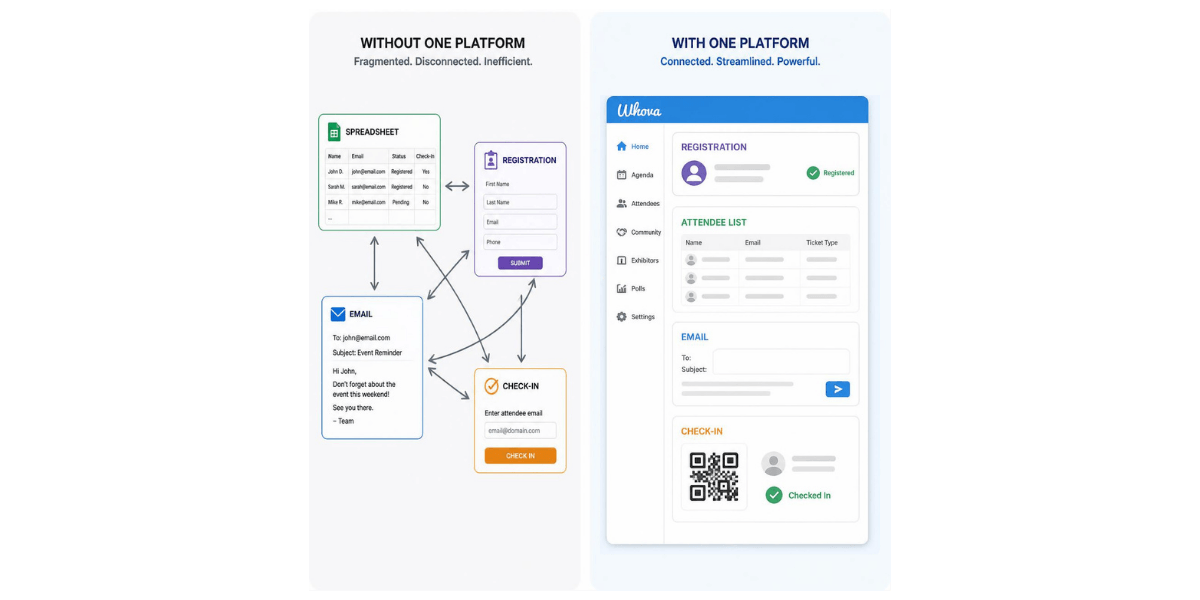
Managing an event across spreadsheets, email threads, and separate tools works until it doesn’t. Data entry errors accumulate. Updates get missed. When no one has a complete picture of where things stand, the delays compound quickly in the weeks before the event.
Dedicated event management software puts everything in one place, which means fewer handoffs and fewer errors. Standalone event registration software handles ticketing and stops there, which leaves you buying a mobile app, a check-in system, and an analytics tool separately. Whova covers the full event lifecycle from a single interface:
- Integrated registration and ticketing
- On-demand badge printing
- In-app attendee networking
- Real-time analytics and reporting
- On-site check-in kiosk and mobile app
- Email campaigns and social media visuals
- Speaker and abstract submission management
How Event Management Can Be Streamlined For Small Teams?
Most event management tools are built with large teams and dedicated IT departments in mind. For associations and smaller organizations, that means paying for complexity you do not need and spending time that nobody has on setup.
Whova is designed to work without a development team behind it. Ready-to-use templates cover registration pages, email campaigns, name badges, and event websites, so your team can get set up quickly without building anything from scratch. Survey reminders can be scheduled in advance, certificates can be generated and distributed in minutes, and QR code check-in removes the need for manual processing at the door.
The result is a small team that can manage a complex event without being stretched across ten different tools to do it.
If you want a practical starting point, our event planning checklist covers the details that most teams forget until it is too late.
FAQs About Event Management
What is event management?
Event management covers everything involved in bringing an event to life, from setting the initial objectives and budget to coordinating vendors, managing registrations, running the day itself, and reporting on results afterwards.
Why is event management important?
A well-run event builds trust, drives engagement, and generates revenue through registrations, sponsorships, and renewals. Poor management puts all of that at risk. Because most events offer no second chance at a first impression, the operational detail matters as much as the programme itself.
What does an event manager do?
An event manager oversees every moving part of an event: defining goals, sourcing venues and vendors, managing registration, coordinating promotion, running on-site operations, and producing post-event reports. On any given day that might mean negotiating a supplier contract, briefing a check-in team, or troubleshooting a last-minute schedule change.
What are the stages of event management?
Most events follow six stages: defining goals and setting a budget, sourcing venues and vendors, building the registration process, promoting the event, executing on-site operations, and analysing results afterwards. Each stage feeds into the next, which is why gaps in the early stages tend to show up as problems on event day.