
By: Whova Team | Last Updated: April 20, 2025

The best conference management software for academics depends on the complexity of your submission and review process as well as your event management needs such as registration and agenda scheduling. For full-scale academic events with abstract management, registration and networking, Whova and Ex Ordo lead the field; for computer science conferences running on a tight budget, EasyChair is a reliable option.
This guide puts eight platforms head-to-head, each evaluated on blind peer review support, key event management features, customer service, and pricing, so you can find the right fit for your event, your discipline, and your workflow.
Comparison Table
| Software | Best For | Review Type | 2026 Event Management Key Features | Pricing Format |
| Whova | Full all-in-one conference management | Single & double-blind | + Custom submission forms
+ Reviewer assignment + HotCRP import + Agenda builder integration + Registration with multiple ticket types and attendee segmentation |
Per event. Custom quote |
| Oxford Abstracts | Dedicated conference management with transparent pricing | Single & double-blind | + Automated reviewer assignment
+ Submission analytics + Website builder |
Tiered. Free tier available |
| Ex Ordo | Recurring annual conferences with strong peer review needs | Single & double-blind | + Multi-track submissions
+ Reviewer matching + Print-ready proceedings + Integrated registration |
Custom quote |
| EasyChair | Conferences on a tight budget | Single & double-blind | + Reviewer bidding
+ Conflict detection + IEEE/ACM/Springer integration + Registration forms |
Free tier. Paid plans available |
| Cvent | Large institutions needing enterprise-level logistics | Limited | + Venue sourcing
+ CRM integration + Submission workflows + Custom registration forms |
Custom quote. Annual licence |
| ConfTool | Complex peer review with configurable workflows | Single & double-blind | + Configurable workflows
+ Multi-track support + EasyChair export + Online registration |
Tiered. Free for small events |
| Microsoft CMT | Conferences needing free, scalable peer review | Single & double-blind | + Unlimited submissions
+ TPMS reviewer matching + Reviewer bidding + Multiple role assignments |
Free. University email required |
| OpenConf | Conferences and journals needing multilingual support | Single & double-blind | + Reviewer bidding
+ Auto-assignment + Proceedings generation + Author rebuttal |
Tiered. Self-hosted option |
Key Takeaways
Short on time?
- The right conference management software will reduce admin work, save time and simplify scheduling and engagement.
- For all-in-one conference management, choose Whova.
- For free, high volume CS peer review, choose Microsoft CMT.
- For conferences with tight budget, check out Easy Chair.
- For international multilingual support, go with OpenConf.
- For enterprise-level events with venue sourcing, consider Cvent.
Why Conference Management Software is Helpful for Academic Conferences
The right software makes sure your conference planning stays on track from the first submission to the final session, along with these advantages:
Less Admin Work
The right platform takes repetitive tasks off your plate so you can focus on the program itself. Submission confirmations, deadline reminders, and decision notifications run automatically.
More advanced platforms also handle reviewer matching and conflict of interest detection, though final assignment decisions stay with the organizer. Additionally, conference management platforms have registration, networking and agenda scheduling features that further streamline your workflows.
Time Savings
A dedicated platform gives organizers a clean, trackable pipeline for incoming abstracts. Originally, submission collection through email or spreadsheets created version control issues and missed deadlines.
But now having everything in one system, from call for papers to post-event reports, saves you time at every stage. You can setup registration forms quicker with customizable question forms and ticket types. Additionally, check-in and networking features can save up time up managing logistics.
One Tool for Scheduling and Engagement
When the event arrives, the last thing an academic conference organizer needs is extra complexity. The best conference management software keeps scheduling and attendee engagement in the same environment. Attendees can network, ask questions, and give feedback while you can manage multi-track sessions and room assignments, all without leaving the platform.
How We Evaluated Each Platform
Not all conference management software is built for academic use. Many platforms are designed for corporate events and retrofitted with abstract management software as an afterthought. To make this list, each platform had to prove itself across five specific criteria.
- Best For: We looked at which audience each tool is built for, whether that is large multi-track symposia, independent research workshops, or hybrid academic events, and where each one outperforms the rest.
- Blind Peer Review Support: Each platform was evaluated on whether it supports single blind and double blind review, and how well it handles coordination between reviewers, authors, and organizers.
- Key Features: We assessed functionality, from submission form customization and multi-track scheduling to proceedings export and attendee engagement tools. Additionally, registration and agenda scheduling features are an important aspect to make the software complete for large conferences.
- Customer Support: Responsiveness and available support channels were also considered, because when something goes wrong, speed is paramount.
- Pricing Format: We clarified how each platform charges, whether per event, per submission, or through annual licensing, so you can assess fit before you commit.
Top 8 Software Solutions for Academic Conferences
1. Whova
Quick Verdict: Whova is a full conference management platform with abstract submission and management, peer review, agenda scheduling, registration and award-winning event app.
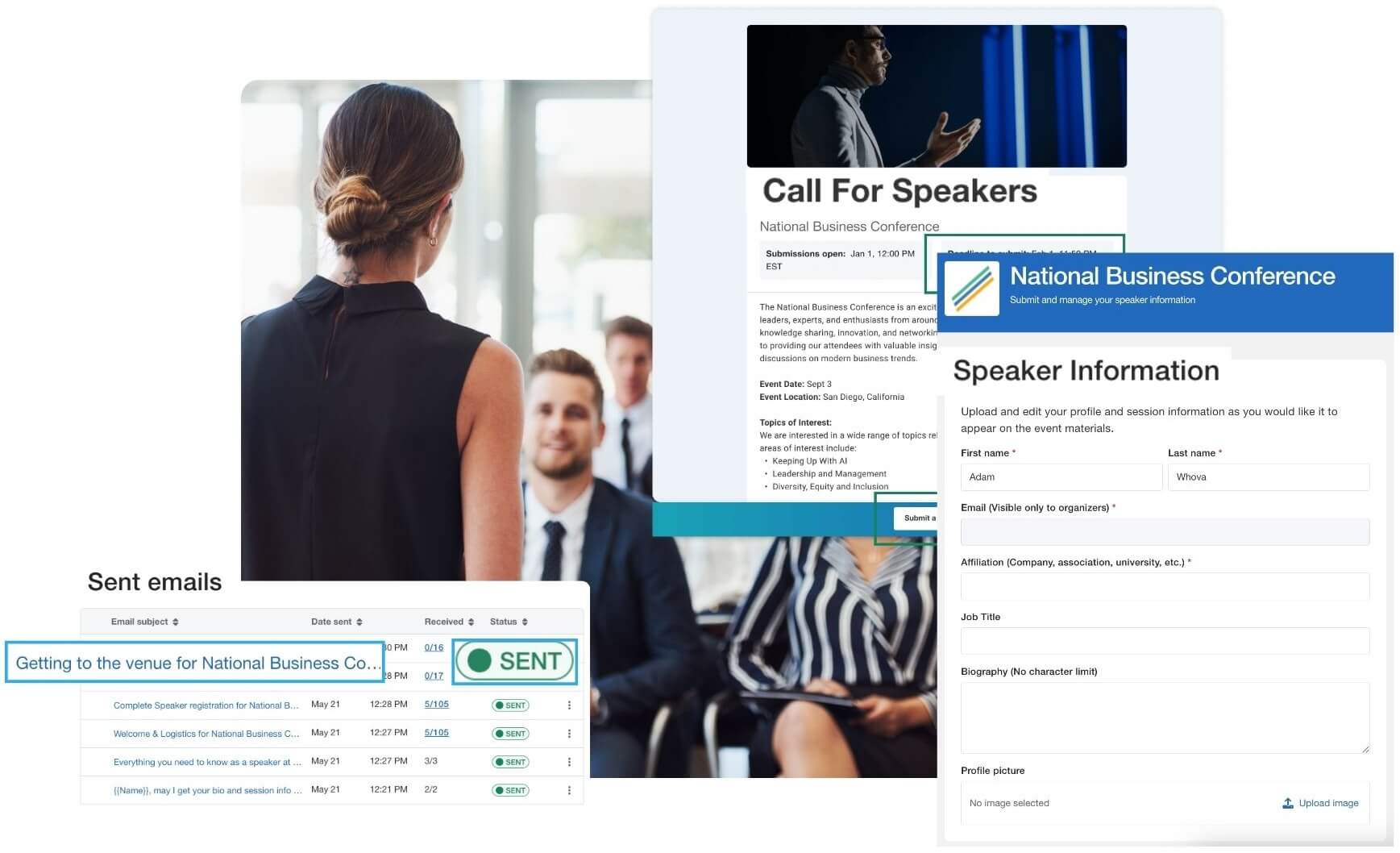
With 15+ years in the event management space, 50,000+ events hosted across 170+ countries, and 15 million users on the platform, Whova gives academic organizers peer review and submission workflows sitting inside the same platform as their agenda, registration, attendee app, event website and speaker management. The platform is ideal for teams that want everything from submission review, attendee management and attendee engagement running on the same platform.
Best For:
- Academic conferences, association events, and business conferences
- Organizations that need abstract management as part of a broader event management setup, rather than as a standalone tool
Blind Peer Review Support:
- Single and double-blind review supported
- Conflict of interest detection built in
- Customizable evaluation rubrics
Key Features:
- Fully customizable abstract submission forms
- Abstract reviewer assignment by track or manual selection
- Custom tags to flag and filter abstract submissions across tracks
- Automatic reminders for incomplete abstract submissions
- Accepted submissions flow directly into the agenda builder as sessions
- HotCRP and OpenReview integration for importing accepted peer-reviewed submissions straight into scheduling without reformatting
- Event registration with customizable ticket types and questions forms integrated with on-site check-in and name badge printing
- Messaging and networking features available for attendees
- Speaker management with speaker personal information collection forms, dedicated messaging and website promotion tools
Customer Support:
- Available via email, phone, and live chat
- Dedicated account manager for onboarding and follow-ups
Pricing Format:
- Custom-quoted per event and requirements
- Abstract management is available as an add-on

2. Ex Ordo
Quick Verdict: Ex Ordo is a conference management and peer review platform for scientific, medical, and technical conferences.
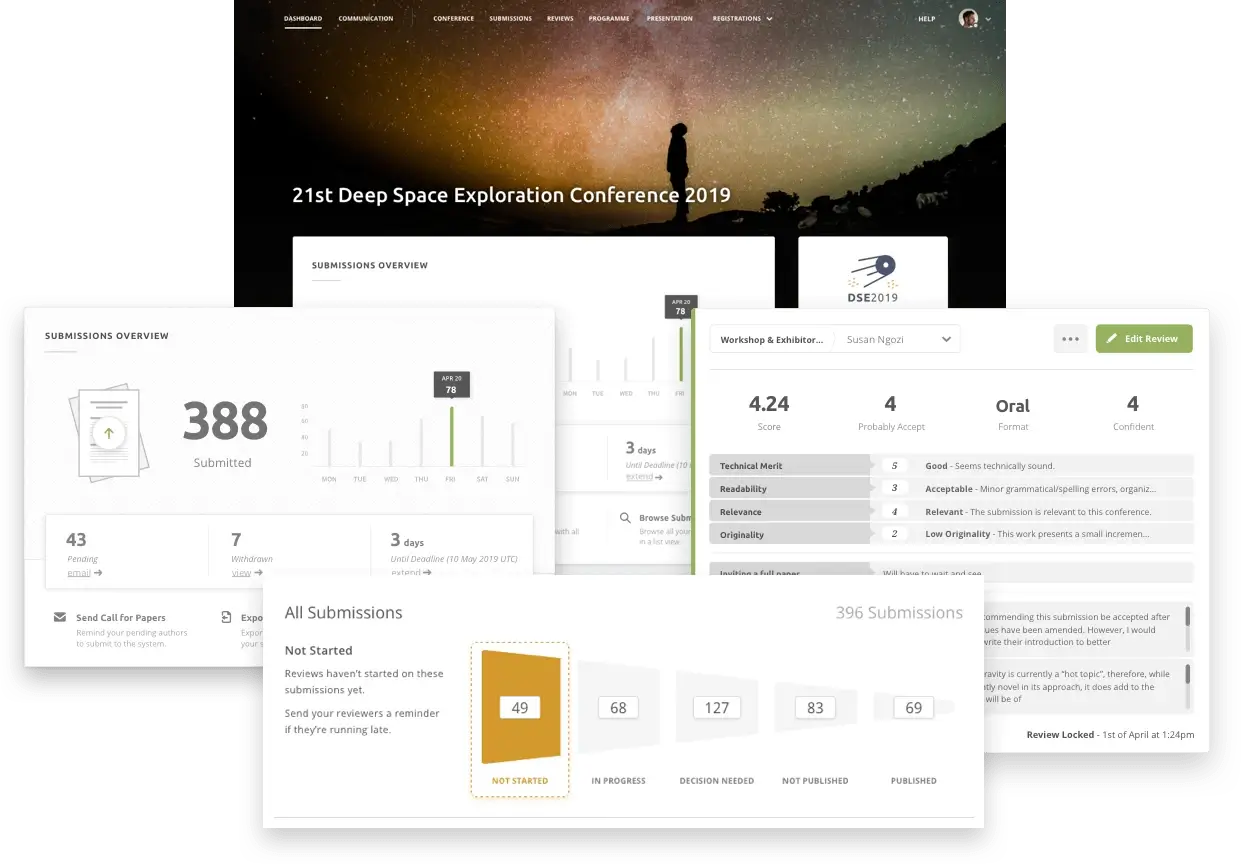
Image credit to Ex Ordo
In 2008, engineering student Paul Killoran was asked to help his supervisor run an academic conference. When he could not find software that handled abstract submissions properly, he built his own. Today, Ex Ordo is used at research conferences in 60 countries, with 13 of the top 20 universities on its client list.
Best For:
- Scientific societies and research institutions
- Organizations running recurring annual conferences
Blind Peer Review Support:
- Single and double-blind review available
- Reviewer names are never shared with authors
- In double-blind, author identities stay hidden from reviewers throughout the process
Key Features:
- Submissions across multiple tracks, each with its own deadlines
- Automated reviewer matching based on expertise
- Print-ready book of proceedings generated directly from accepted submissions
- Registration tracking and reminders
Customer Support:
- Onboarding included for all customers
- 17+ years in the industry
- 90-minute response time SLA
Pricing Format:
- Custom-quoted on request
- Starter option available for smaller events with up to 125 submissions
3. Oxford Abstracts
Quick Verdict: Oxford Abstracts is a dedicated abstract and conference management platform with transparent pricing and multilingual support.
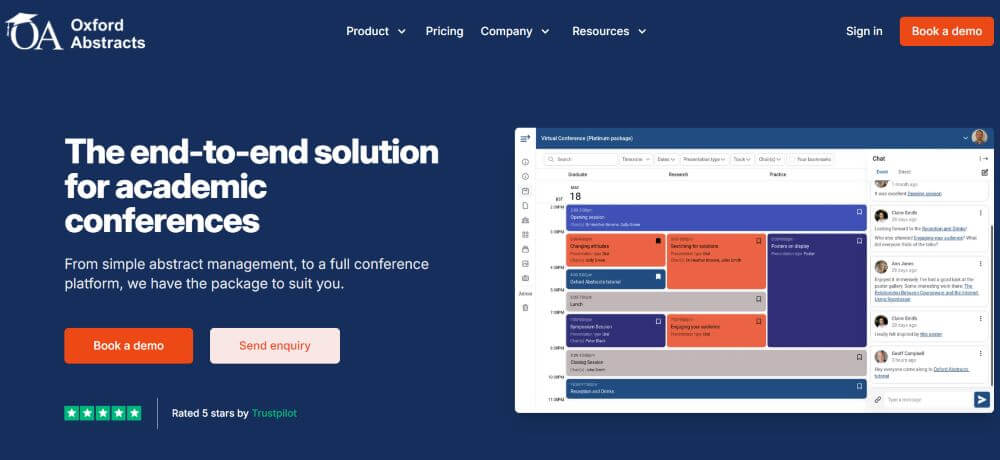
Image credit to Oxford Abstracts
Oxford Abstracts has spent twenty years building exclusively for academic conferences, making it one of the strongest Ex Ordo alternatives. A free tier, fully transparent per-event pricing, and a 4.9-star Trustpilot rating from over 400 reviews set it apart from most platforms in this category.
Best For:
- Internationally distributed events with multilingual submitter bases
- Organizers who want a dedicated abstract management platform with predictable pricing
Blind Peer Review Support:
- Single and double-blind review available
- Author identities stay hidden from reviewers throughout
- Reviewer names never disclosed to submitters
Key Features:
- Automated Reviewer Assignment Tool that distributes abstracts based on custom rules
- Submission Analytics tracking where submitters find your call for papers
- Multilingual submission support
- Website Builder with six pre-built templates, integrated directly with conference content
- Private, group and video chats
Customer Support:
- Dedicated support desk included with all plans
- Consistently flagged in reviews as a standout
Pricing Format:
- Per-event pricing from $890 to $3,450
- Free version available for smaller events
4. Easy Chair
Quick Verdict: EasyChair is a free peer review and submission management platform for computer science and technical conferences.
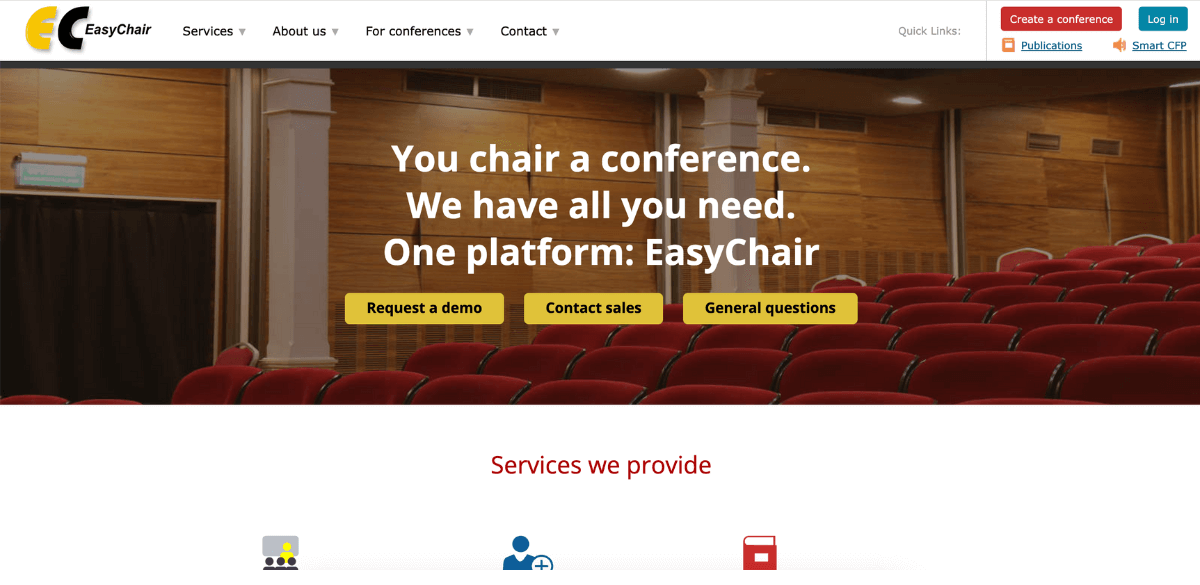
Image credit to Easy Chair
EasyChair has been around since 2002 and remains the default choice for computer science conferences. It is not the most polished platform in this list, but for technical fields where peer review complexity matters more than interface design, it gets the job done, for free.
Best For:
- High-volume peer-reviewed paper submissions
- Conference organizers in computer science and related fields
Blind Peer Review Support:
- Blind reviewing supported
- Conflict detection built in
- Program committee collaboration tools
Key Features:
- Conflict of interest management
- Direct proceedings integration with IEEE, ACM, and Springer
- Multi-track conference support with separate program committees per track
- Reviewer bidding system allowing experts to self-select papers based on their own expertise
- Agenda scheduling with pre-made templates
- Flexible and easy to use registration forms
Customer Support:
- Helpdesk included across paid plans
- Dedicated EasyChair manager available on VIP tier
- Limited support on the free plan
Pricing Format:
- Free for organizers
- Optional paid services for proceedings publishing and premium support starting at €500 per conference
5. Cvent
Quick Verdict: Cvent is an enterprise event management platform for large-scale academic and institutional conferences.
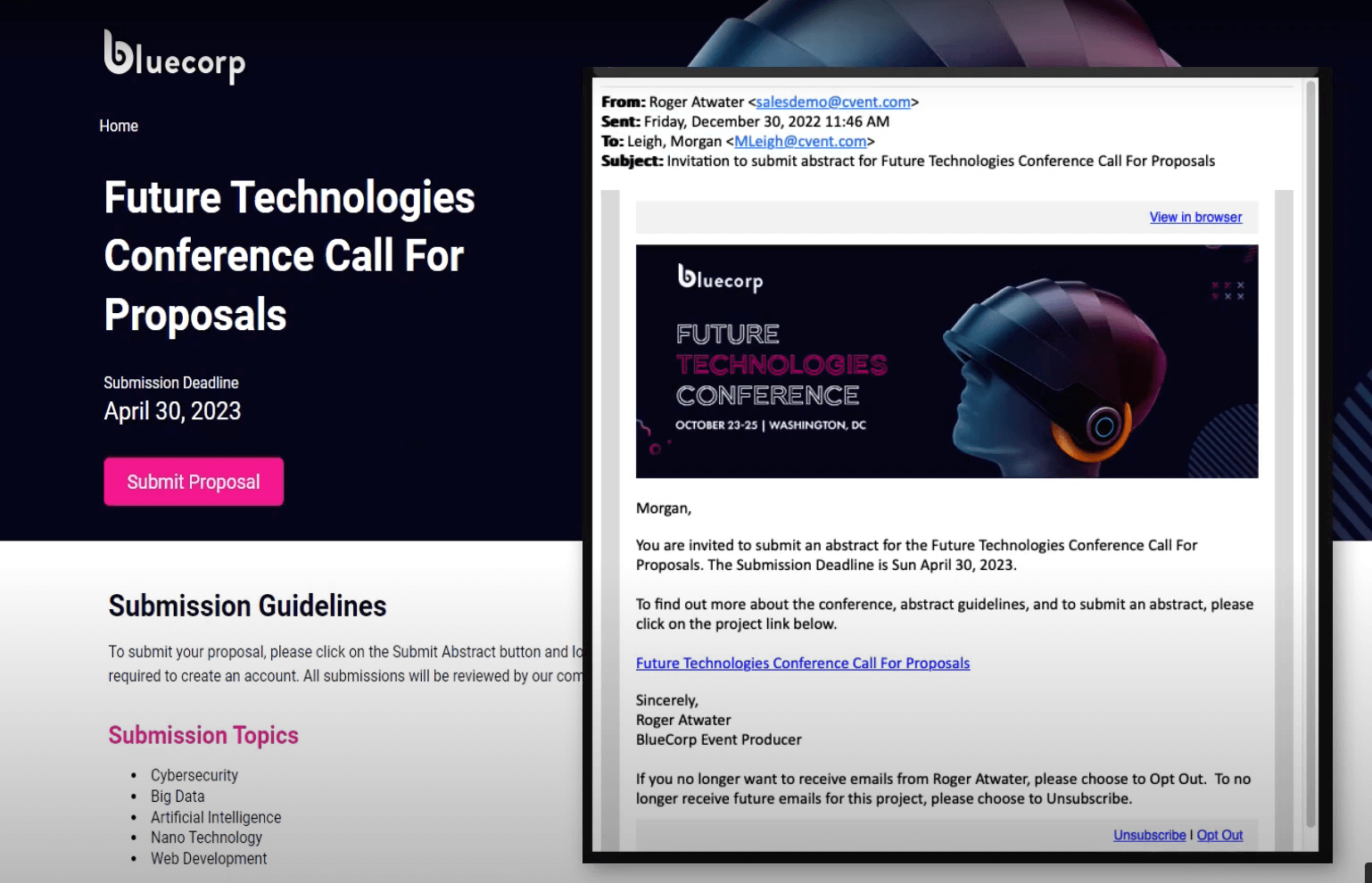
Image credit to Cvent
Where most platforms in this list serve a single niche, Cvent is built to handle any event at any scale. For academic organizers, that breadth is both the appeal and the trade-off: the logistics infrastructure is unmatched, but abstract management and peer review are not where it shines.
Best For:
- Large academic institutions or associations running major annual conferences
- Organizations needing enterprise-level logistics, venue sourcing, and attendee management alongside academic programming
Blind Peer Review Support:
- Not purpose-built for academic peer review
- Lacks dedicated submission and review workflows that specialist platforms offer
Key Features:
- Global venue sourcing database
- CRM integration and automated marketing tools
- Post-event analytics built for institutions running large attendee pipelines
- Event website builder for registration and event information
- Agenda and speaker promotion tools
Customer Support:
- Support community available
- Dedicated account management
Pricing Format:
- Custom-quoted
- Structured as an annual licence fee plus a per-registrant fee
6. ConfTool
Quick Verdict: ConfTool is an academic conference management platform with configurable submission and peer review workflows.

Image credit to Conftool
ConfTool has been a constant in academic conference management for over two decades and regularly comes up when organizers search for OpenConf alternatives. For program committees that need highly customizable submission and review workflows without paying for features they will never use, this platform consistently delivers.
Best For:
- Academic conference chairs managing mid-to-large peer-reviewed events
- Organizers who prioritize workflow flexibility over interface design
Blind Peer Review Support:
- Single and double-blind review supported
- Customizable workflows with granular control over how evaluations are structured and managed
Key Features:
- Multi-track support
- Customizable submission forms
- GDPR-compliant data handling
- Personal timezone management tool for international events
- Direct export to EasyChair for committees already embedded in that ecosystem
- Customizable registration form with discount codes and multiple payment options
Customer Support:
- Consistently flagged as fast, knowledgeable, and easy to reach by email
- Strong responsiveness that compensates for a less polished interface
Pricing Format:
- Scales to €2,000+ for larger events
- Usage-based, starting at around €300 for up to 50 submissions
- Free standard version available for smaller events with up to 150 participants
7. Microsoft CMT
Quick Verdict: Microsoft CMT is a free, scalable peer review platform for academic institutions, sponsored by Microsoft Research.
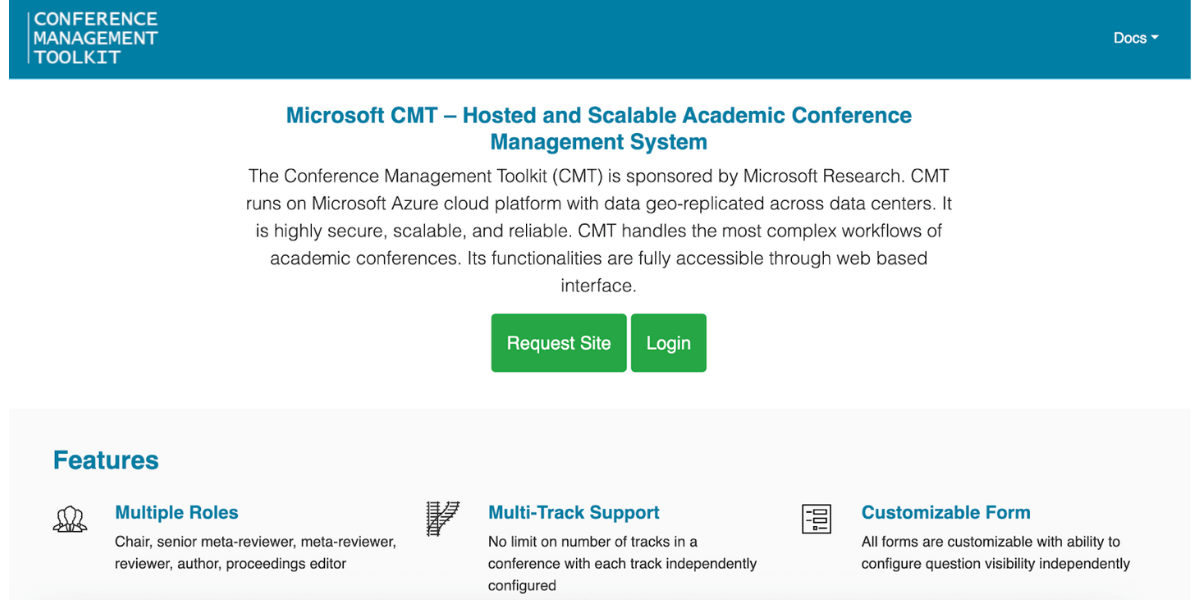
Image credit to Microsoft CMT
Microsoft CMT has over one million users across 240 countries and has hosted more than 12,000 conferences. It runs on Microsoft Azure infrastructure and costs nothing. The catch: access is restricted to current university faculty, and the platform covers peer review only, not event logistics.
Best For:
- Computer science and technical research conferences
- Organizations needing a free, highly scalable peer review system
- Teams comfortable with a setup process that rewards experience
Blind Peer Review Support:
- Single and double-blind review supported
- Automated reviewer assignment through TPMS, a paper matching system that pairs submissions to reviewers based on research expertise
Key Features:
- No cap on submissions or tracks
- Fully customizable forms
- Reviewer and meta-reviewer bidding built in
- Unlimited file uploads covering PDF, DOCX, audio, and video
- Multiple reviewer role assignments
Customer Support:
- Help Center ticketing system
- Solid response quality despite being a free service
- Conference-specific queries routed directly to conference chairs rather than platform support
Pricing Format: Completely free. Sponsored by Microsoft Research and available exclusively to academic institutions with valid university email addresses.
8. OpenConf
Quick Verdict: OpenConf is a peer review and abstract management platform for conferences and journals with multilingual support.
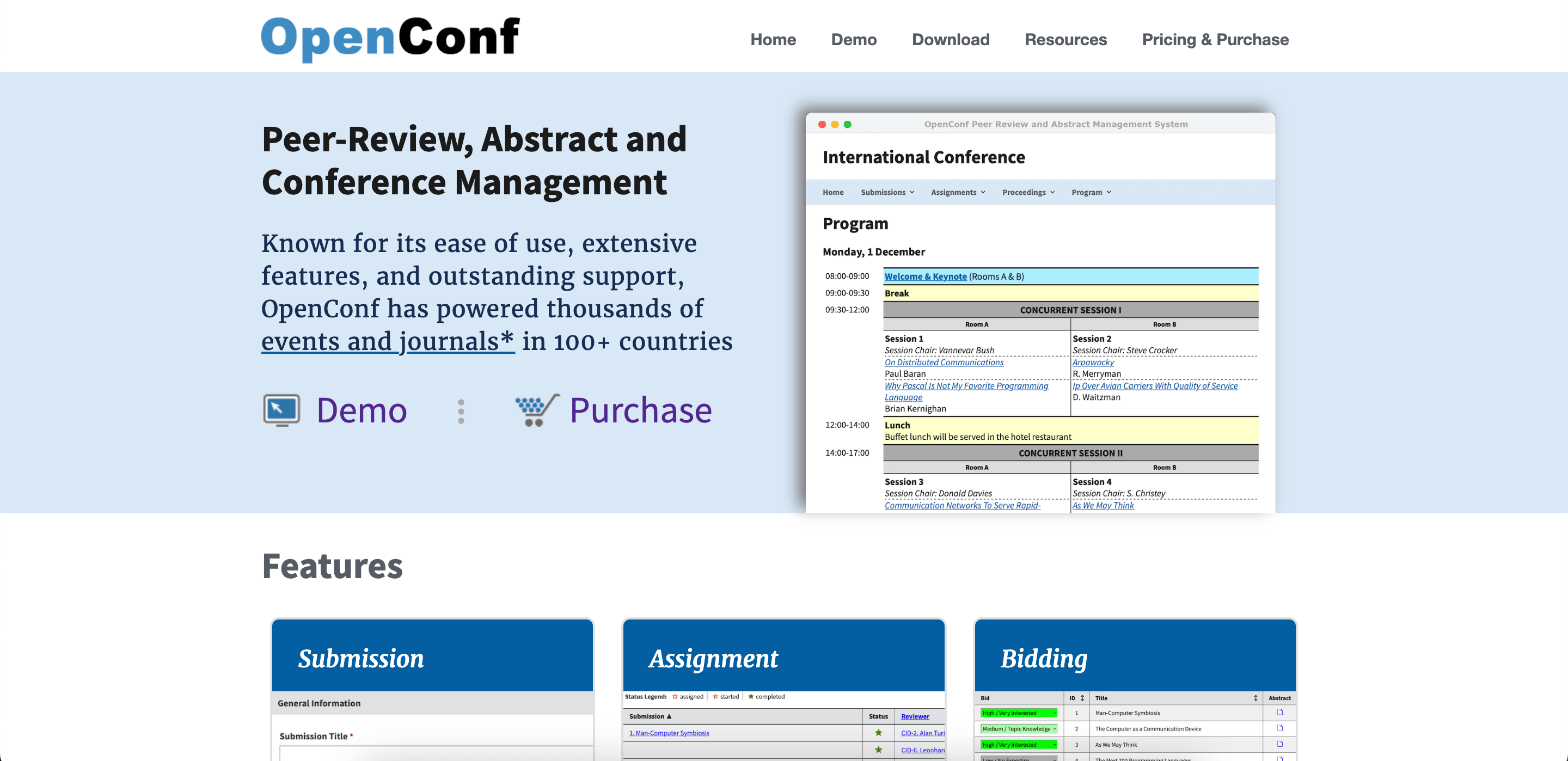
Image credit to OpenConf
OpenConf is more polished than EasyChair, more affordable than Oxford Abstracts, and more flexible than Microsoft CMT, without being restricted to any single discipline. Used by thousands of events and journals across 100 countries and 15 languages, it covers the full conference lifecycle without overcomplicating the setup.
Best For:
- Academic conferences and journals
- Organizations needing solid peer review and abstract management with multilingual support
Blind Peer Review Support:
- Single and double-blind review supported
- Fully customizable review forms
- Reviewers can bid on submissions or be assigned automatically by topic
Key Features:
- Multilingual support across every user interface
- Submissions, reviewer bidding, auto-assignment, program scheduling, and proceedings generation in one place
- Self-hosted option available for institutions that need to keep data on their own servers
- Author rebuttals
Customer Support:
- Accessible and responsive team
- Strong fit for organizers without dedicated technical support in-house
Pricing Format:
- Self-hosting also available
- Tiered pricing starting at $595 for up to 100 abstracts
- Scales to $2,995+ for 5,000 submissions
Which Platform is Right for You?
Academic conference management software has come a long way. Platforms that once handled only abstract submissions now cover everything from peer review to attendee networking, agenda building, and post-event analytics.
For smaller or highly technical conferences, free and low-cost options like Microsoft CMT and EasyChair hold up well. For organizers who want a purpose-built academic platform without enterprise pricing, Oxford Abstracts, Ex Ordo, and ConfTool all make a strong case.
For those who want abstract management, attendee experience, and event logistics in one platform, Whova covers the full conference workflow from submission to closing keynote.
Schedule a demo to see it in action.
FAQs About Conference Management Software
What is the best software for academic abstract management in 2026?
Oxford Abstracts is a good option, with transparent pricing and strong peer review workflows. Microsoft CMT delivers enterprise-grade reliability at no cost, making it the go-to for computer science conferences on a tight budget. For organizers who need abstract management alongside a full attendee experience, Whova is a top pick.
Can I use Whova for academic peer review and abstract submissions?
Yes. Whova’s abstract management software handles the full submission and review cycle, including customizable submission forms, reviewer assignment, and progress tracking.
Is there a free version of academic conference management software?
Yes. Microsoft CMT is completely free. EasyChair also has a free tier covering core submission and review functionality. For a fuller feature set, platforms like Whova offer custom pricing based on event size and requirements.
Are academic conference platforms GDPR and SOC 2 compliant?
Most leading platforms are GDPR compliant and many hold SOC 2 Type II certification. That said, compliance levels vary by provider, so it is worth verifying directly with any platform you are considering.