
Author: Whova Team | Last updated: December 08, 2025

Looking for event trends to watch in 2026?
The economic climate has been unpredictable, and organizers are responding in different ways. Conference planners are chasing ROI and new revenue streams. Nonprofits are stretching budgets while protecting mission impact. Corporate teams are proving value to leadership with fewer resources.
Despite the pressure, the market is growing. From 2026 to 2033, the global event market is projected to reach $3,491.23 billion, but capturing that growth means keeping up as conditions shift.
In this blog, we’ll cover the trends shaping 2026 that event organizers can’t afford to ignore: smarter data tracking, hybrid formats, rising costs, sponsorship as revenue, sustainability, and offline backups.
1. Powerful Data Tracking and Easier Access to Event Management Tools
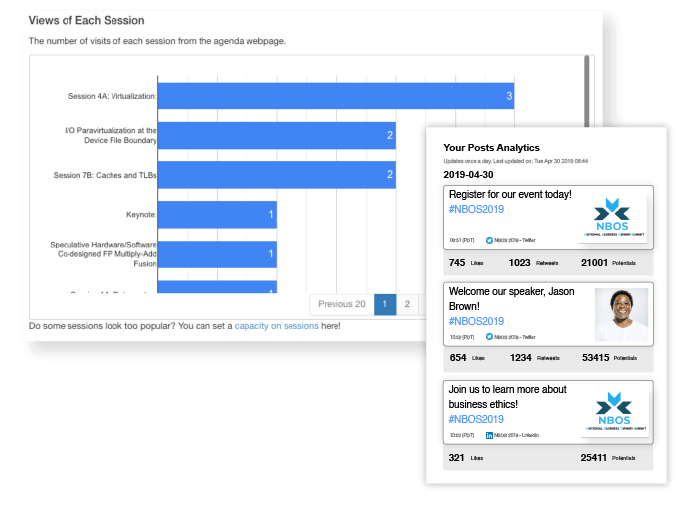
A strong event strategy runs on data. How many people showed up to each session? Which workshops hit capacity? Which ones had attendees slipping out after fifteen minutes?
If you want attendees to come back, you need to know what worked and what didn’t. And if you’re asking sponsors to return, they’ll want exact numbers on booth impressions, not rough estimates.
Not long ago, tracking this meant juggling spreadsheets from five different vendors. Ticketing in one, check-ins in another, survey results somewhere else. Now, event management tools bring it all together. Platforms that handle event logistics can manage ticketing, check-ins, session tracking, and engagement metrics in one place. The data lives together, and it’s accessible in real time.
How does this affect event organizers?
Without this data, you’re defending your budget with gut feelings. With it, you can show leadership that the keynote pulled a 94% attendance rate or the afternoon breakout barely hit 40%, and make a case for restructuring next year’s schedule. You can prove which ticket tiers sold fastest, which speaker topics drove the most interest, and where your marketing landed.
Easier data collection means more informed decisions and fewer expensive guesses. The challenge now isn’t access. There are dozens of platforms out there. It’s choosing the right one for your event size, budget, and the data you need to report on.
What can be done?
When choosing a platform, look for:
- Real-time visibility: Can you see app downloads, sponsor banner views, and attendee participation while the event is still running? You want to catch problems before it’s too late to fix them.
- Post-event reporting: Reports should break down session views, networking activity, and sponsor impressions without you having to dig through raw data.
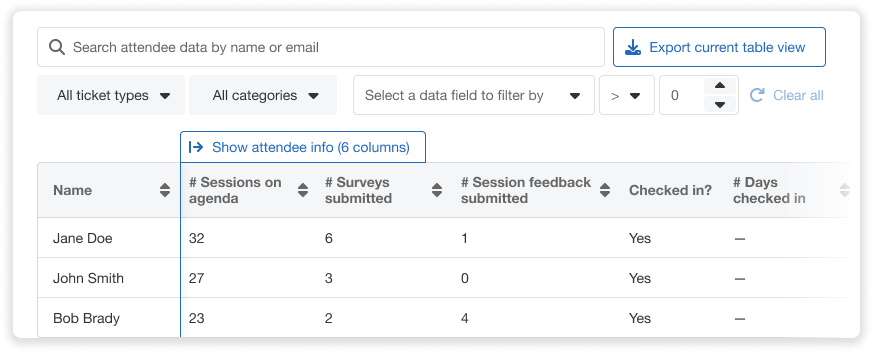
- Easy exports: Can you generate custom reports that pull check-ins, survey responses, and registration data into one file? If you’re manually stitching spreadsheets together, the platform isn’t doing its job.
2. Prevalence of Hybrid Events
In-person gatherings are back, but virtual participation isn’t going anywhere. Not everyone can show up in person, and after years of virtual events, many attendees expect remote access anyway. Hybrid event formats meet both needs.
Case in point: More than 123 million hybrid events took place in 2025, making it the fastest-growing segment in the industry. Better technology, corporate demand for flexibility, and evolving audience expectations have all driven this growth.
How does this affect event organizers?
Hybrid no longer requires a massive production budget. A single platform can now manage your livestream, sync your virtual and in-person agendas, and let both audiences participate in the same Q&A or poll in real time. And that’s worth taking advantage of.
For instance, a research conference benefits from international attendees who can’t justify the travel. An industry association also gains when members across different locations can participate live. The barrier to entry is lower than ever. Whether a hybrid event makes sense just depends on your event goals.
What can be done?
There are plenty of event platforms out there, but not all handle hybrid formats well. Look for the ones that let you manage both virtual and in-person attendees from a single system, rather than cross-referencing between separate tools.
With Whova, for example, registration, announcements, and engagement all run from one dashboard, so remote attendees aren’t an afterthought. Plus, gamification features like leaderboards and photo contests work across web and mobile, keeping virtual participants actively involved.

3. Uncertainty of Rising Costs
Inflation continues to push prices higher, and event budgets are feeling the squeeze. The cost per meeting attendee per day is expected to rise 4.3% to $169, with food, beverage, venue, and labour all more expensive than they were a year ago.
But rising prices are only part of the problem. Tariffs and shifting trade policies are making it harder for venues and vendors to commit to rates far in advance. In fact, 82% of meeting professionals expect event expenses to increase solely due to tariffs. Therefore, the number you budget today may not hold six months from now.
How does this affect event organizers?
As a result, more than 30% of small and medium-sized event planners hosted fewer events this past year. International and major events face even more hurdles with permits, safety guidelines, and cross-border restrictions, even as demand for immersive and hybrid experiences grows.
What can be done?
The best way to manage this uncertainty is to build flexibility into your budget from the start. A contingency fund of 10-15% of your total budget gives you room to absorb price shifts without scrambling to cut corners elsewhere. Beyond that, look for ways to streamline.
If you’re paying separately for registration, email marketing, engagement tools, check-in software, and an event app, those subscriptions can easily run $300-800 per month before you factor in the time spent managing them all.
Platforms like Whova consolidate everything into one system and automate tasks like badge generation, session reminders, and attendee communication. That means fewer subscriptions, less manual work, and real-time savings.
As Brenda Rigdon, Executive Director of the Michigan Historic Preservation Network, put it: “By using Whova and funneling people through the website, we cut our labor by over 200 hours.”
Additionally, you can still provide great value to your attendees and still get high ROI with smaller events. Micro events can help cut costs of managing and planning a big conference. You won’t need spacious venues or complicated logistics to maintain thousands of attendees. Yet, these types of events provide more concentrated and topic focused experiences such as webinars, workshops or networking events so that attendees can get what they came for at a lower cost.
4. Corporate Sponsorships as Core Revenue Source
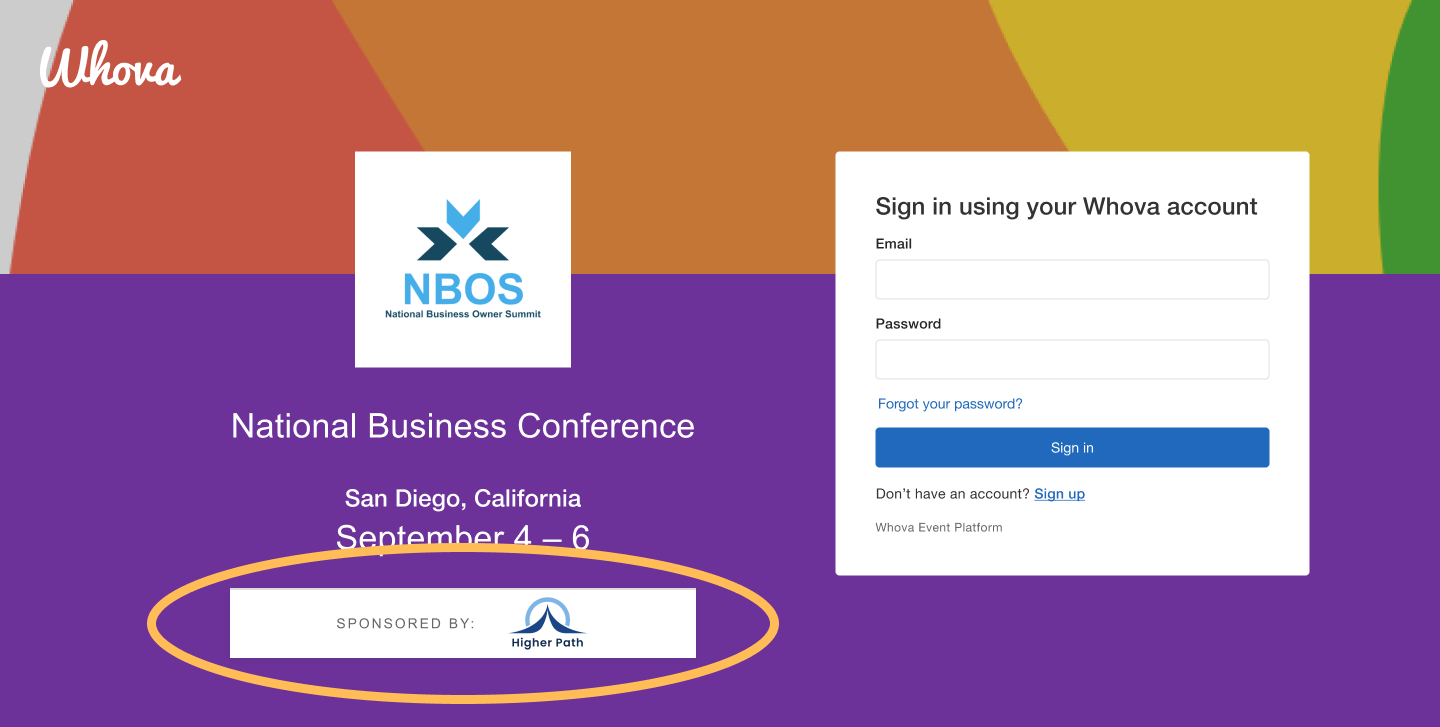
Did you know? Sponsorship and branding generated more than $110 million in revenue-earning instances in 2025, outpacing every other revenue source in the event industry. Brands want experiential marketing, influencer relationships, and integrated programs. Events are able to deliver all three in ways digital ads struggle to match.
When the economy gets shaky, ticket sales get unpredictable. Sponsorships give you a second revenue stream. The organizers who are paying attention are treating it as a core part of their revenue model from day one.
How does this affect event organizers?
If sponsorship revenue is growing across the industry and you’re not capturing any of it, your competitors are. They’re building relationships with brands you could be working with. They’re funding better programming, better venues, better experiences. And when those brands allocate next year’s budget, they’re going back to the organizers who delivered.
Meanwhile, organizers who are still relying only on ticket sales and exhibitor fees are stuck. Thinner margins. Fewer resources. Less room to invest in the event itself. When it comes to managing event costs, there’s no cushion. Costs rise, attendance dips, and you end up cutting corners. Attendees notice. It’s a cycle that’s hard to break once you’re in it.
What can be done?
Sponsors care about one thing: exposure they can see and measure. So give them that.
First, make it easy for them to buy in. Tiered packages (Gold, Diamond, Platinum) let sponsors self-select based on budget. À la carte options let them pick specific exposure opportunities and do it well. Offer both for maximizing revenue.
Then deliver on the exposure. Put their brand where attendees are looking: banners in announcements, on registration pages, in surveys, on the app entry page, and in confirmation emails. Consider all opportunities that can happen before the event, during and after.
Finally, prove it worked. Show sponsors exactly how many impressions they got. When renewal conversations come around, you’re showing proof, and that makes the next yes easier.
5. Eco-friendly Events
The plastic water bottles are piling up by the bins. The printed schedules left behind on chairs. The catering trays scraped into garbage bags at the end of the day. Attendees see all of it. And increasingly, it shapes whether they come back.
44% of event attendees are more likely to revisit events that demonstrate environmental responsibility. 77% are willing to pay more for sustainable options. And as a priority, sustainability jumped from 11% in 2023 to 18% in 2024. This isn’t optics alone. Sustainable practices can lead to savings: 20–30% lower costs and 60–80% less waste.
How does it affect event organizers?
Sustainability used to be something you mentioned in a footnote. Now it’s something attendees look for before they register. Younger audiences, especially, are making decisions based on whether your event aligns with their values. And in an age where anyone can post a photo of overflowing bins to social media, the reputational risk of getting it wrong is real.
The pressure is coming from multiple directions. Attendees are factoring sustainability into which events they choose. Sponsors want to associate with events that align with their own ESG commitments. And some venues are starting to require sustainability practices as part of their booking terms. As a result, 73% of organizers now prioritize sustainability.
What can be done?
Start with your supply chain. Catering, signage, swag. Eco-friendly alternatives often exist at a similar cost. Choose local suppliers where possible to cut transport emissions. If you’re making changes, say so in your event communications. Attendees want to support events that align with their values.
Look at waste. Swap single-use plastics for reusable or compostable options. Set up clear recycling stations. Work with caterers to reduce food waste and donate what’s left over.
Event apps help here, too. Digital platforms reduce the need for printed materials by up to 80%. No more boxes of programs, no more last-minute reprints. One less thing to print, one less thing to throw away.
6. Offline Backups
On October 20, 2025, Amazon Web Services went down. For over 15 hours, a DNS issue at a single data centre in Virginia took out more than 1,000 companies. Snapchat, McDonald’s, NBC News, Ring, Roblox, Fortnite, all offline. United Airlines had to switch to backup systems when its app and website stopped working.
At first, everyone thought it was a cyberattack. It turned out to be a technical failure that cascaded across the internet, costing billions. Technology fails. Even the biggest platforms go down.
How does it affect event organizers?
Over-reliance on online systems creates a single point of failure. When the platform goes down mid-event, so does your registration desk, your schedule, and your attendee communications. Staff scramble, attendees get frustrated, and the experience falls apart.
The damage can extend beyond the event itself. Attendees may remember the disruption more than the content. Sponsors may question whether their investment was worth it. For paid events, refund requests can follow. Trust is hard to rebuild.
What can be done?
Have a plan B. Most event management tools offer export functions for precisely these reasons. With Whova, you can export your agenda, speaker details, attendee lists with specific segmentations, check-in data, and more. Download it all to a local drive or laptop.
That way, if the internet disappears, you’ve got what you need. Print a few emergency schedules. Keep a backup laptop with local files. An hour of prep can save you a lot of stress and your reputation when things go wrong.
Conclusion: What Are the Next Steps?
Data tracking helps you see what’s working and prove it to stakeholders. Hybrid formats let you reach more people without spending more. Sponsorships bring in revenue when ticket sales are unpredictable. Sustainability cuts waste and costs. And offline backups mean one tech failure doesn’t derail your entire event.
Understanding these trends matters because they shape how you protect your event. But knowing them is only half of it. You need tools that help you act on them.
Our platform brings real-time analytics, sponsor visibility, hybrid event tools, and data exports into one place. You can use AI for event planning to automate tasks like writing event descriptions and generating post-event reports, and our all-in-one approach helps you save money by replacing multiple subscriptions with a single platform.
Want to see how it comes together? Request a demo and let’s talk.
FAQs About 2026 Event Industry Trends
What are the top event trends for 2026?
The six trends shaping 2026 are: smarter data tracking, hybrid formats, rising costs, sponsorship as a core revenue stream, sustainability, and offline backups. Each one reflects how the industry is adapting to tighter budgets, higher expectations, and an unpredictable economic environment.